



A cervical polyp is a small growth on your cervix. It can cause vaginal bleeding. Your healthcare provider can detect cervical polyps during a pelvic exam. They’re usually removed and sent for testing. In most cases, cervical polyps are benign and not a cause for concern.
Advertisement
Cleveland Clinic is a non-profit academic medical center. Advertising on our site helps support our mission. We do not endorse non-Cleveland Clinic products or services. Policy
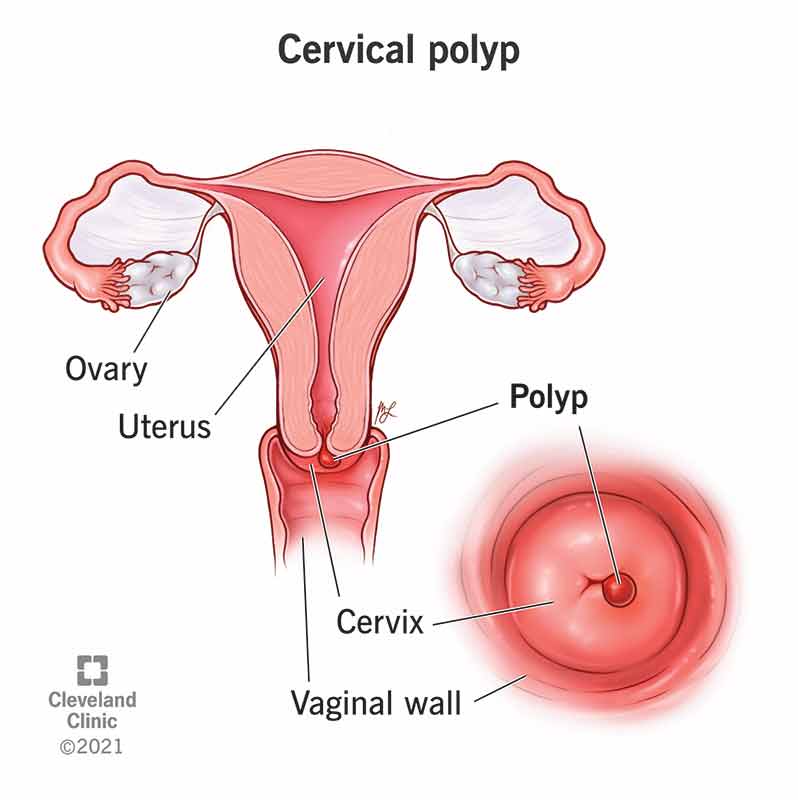
Image content: This image is available to view online.
View image online (https://my.clevelandclinic.org/-/scassets/images/org/health/articles/24436-cervical-polyp)
Cervical polyps are small, irregular growths in or on your cervix. They’re common. The polyps usually grow in the cervical canal (endocervical polyps). Less often, they develop on the outermost layer of the cervix (ectocervical polyps).
Advertisement
Cleveland Clinic is a non-profit academic medical center. Advertising on our site helps support our mission. We do not endorse non-Cleveland Clinic products or services. Policy
Almost all cases are noncancerous. But they can sometimes cause symptoms like abnormal uterine bleeding. Cancerous cervical polyps are possible but very rare, occurring in less than 1% of all cases.
Despite the very low chance of cancer, your healthcare provider may recommend removing a cervical polyp. Testing the tissue is the only way to know for sure that it isn’t cancer. Removing the polyp can also treat any symptoms it causes.
Most cervical polyps don’t cause symptoms. But possible symptoms include:
These symptoms have several possible causes, some of which are more serious than cervical polyps. See your healthcare provider if you notice these changes.
Most polyps are elongated, tear-shaped growths that stick out from your cervix. They’re smooth or slightly spongy in texture. They’re bright red, pinkish to purple or greyish-white.
Some polyps have a long, thin stalk (called a pedicle) attached to them. They’re usually less than 1/2 inch long but can grow larger. They can bleed when you touch them.
Sometimes, a healthcare provider may mistake a uterine fibroid (myoma) for a cervical polyp. They can look similar if a fibroid comes through your cervix.
Advertisement
Researchers don’t know the exact cause of cervical polyps. But they tend to be linked to:
Cervical polyps are most common in women over the age of 20 and those who’ve had more than one child. Cancerous polyps are more common after menopause (but rare overall).
Healthcare providers typically diagnose a cervical polyp during a pelvic exam or Pap smear. They can usually see the polyp once they insert a speculum to widen your vagina.
Your provider may remove the polyp. They’ll send it to a lab for analysis to make sure it isn’t cancerous.
In some cases, your provider may do a transvaginal ultrasound to get a closer look at the surrounding area.
In most cases, healthcare providers will recommend removing a cervical polyp.
The removal of a polyp is called a polypectomy. This typically happens in your provider’s office during a pelvic exam. They may do the procedure in a surgical center if the polyp is large.
Your provider removes small cervical polyps by pulling or twisting them off with a pair of forceps. You aren’t under anesthesia, and it’s a relatively quick and painless procedure.
If there isn’t a base or stalk to grasp or the polyp is large, your provider may use a loop electrosurgical excision procedure (LEEP). This is a surgical method that uses a wire loop heated by an electric current to burn the polyp from the surface of your cervix. Your provider numbs your cervix with an anesthetic before LEEP.
They’ll send the polyp to a lab for testing to ensure there are no signs of cancer.
You can expect to feel mild cramping after polyp removal. You’ll likely have light bleeding, as well. Using an over-the-counter (OTC) pain reliever like acetaminophen or ibuprofen can help.
You should be able to resume your usual activities within a day or two. But you shouldn’t have sex or wear tampons for at least two weeks or until the bleeding has stopped. Talk to your healthcare provider about what to expect after the procedure.
Most cervical polyps are noncancerous and easy to remove. Your healthcare provider will recommend removing the polyp if they feel it’s necessary.
In some cases, cervical polyps can grow back. Getting regular pelvic exams and Pap smears is the best way to find and treat polyps before symptoms start.
If you have a polyp that causes symptoms, the symptoms will likely continue if the polyp isn’t treated. Even though cervical polyps are rarely cancerous, it’s best to know for sure. That’s why removing these polyps and testing them is recommended.
Advertisement
Any type of abnormal growth on your cervix may cause concern. But if it’s a cervical polyp, it’s usually not serious. Most of these polyps don’t cause problems or lead to cancer. To be on the safe side, your healthcare provider may recommend removing it. Don’t hesitate to ask questions about the process and what to expect.
Advertisement



Sign up for our Health Essentials emails for expert guidance on nutrition, fitness, sleep, skin care and more.
Learn more about the Health Library and our editorial process.
Cleveland Clinic’s health articles are based on evidence-backed information and review by medical professionals to ensure accuracy, reliability and up-to-date clinical standards.
Cleveland Clinic’s health articles are based on evidence-backed information and review by medical professionals to ensure accuracy, reliability and up-to-date clinical standards.
From routine pelvic exams to high-risk pregnancies, Cleveland Clinic’s Ob/Gyns are here for you at any point in life.
